Flickering Lights and Birds: Why Stable Lighting Matters
Modern homes and poultry farms often use LED or fluorescent lamps. Many of these lights flicker rapidly – too fast for humans to notice, but not always too fast for birds. For parrots in a living room or chickens in a coop, this invisible strobe effect can be stressful and may affect health, behavior, and productivity. (ScienceDirect)
This article explains what we know about flicker and birds, and gives practical lighting tips for pet bird owners and poultry professionals.
Why birds notice flicker when we do not

Birds see the world faster than we do. Their eyes and brains can detect rapid changes in light intensity – what scientists call critical flicker fusion frequency (CFF).
- Studies in chickens show average CFF values around 75–87 Hz in bright light. (ScienceDirect)
- Poultry in general have reported CFF values between about 20 and 119 Hz, depending on species and light level. (Lohmann Breeders)
- Some wild birds, like small songbirds and raptors, can detect flicker well above 100 Hz, up to about 129–145 Hz in some species. (once.lighting)
Many artificial lights powered from mains electricity flicker at 100–120 Hz (twice the 50/60 Hz mains frequency) or use LED drivers that modulate light output at a few hundred hertz. These can appear completely steady to humans but still be visible to birds, especially at high brightness. (ScienceDirect) Note that even if light looks steady to us, invisible flicker can still cause headaches and eye strain in humans, though that is outside the scope of this article.
So a lamp that looks "fine" to you might look like a subtle – or strong – strobe to a parrot or a flock of hens.
Health and welfare impacts of flicker
Stress and physiological effects
Research in captive European starlings kept under standard fluorescent lighting (100 Hz flicker) found behavioral signs consistent with stress and suggested impaired welfare compared with birds under higher-frequency lighting. (ScienceDirect)
In poultry houses, several studies link problematic flicker with:
- Higher stress indicators
- Reduced growth or poorer feed conversion
- Lower egg production in layers
- Increased mortality in some cases (farmingfuturefood.com)
Conversely, moving to flicker-free or very high-frequency LED lighting has been associated with better growth, more stable behavior, and in some cases improved egg production and lower mortality. (farmingfuturefood.com)
While most data come from farmed chickens and turkeys, the underlying reason is general: long-term exposure to a "shimmering" environment is a chronic stressor for birds whose vision can resolve that flicker.
Eye strain and visual fatigue
Because birds rely heavily on vision – for flight, foraging, and social contact – unstable lighting may contribute to eye strain and visual fatigue. Reviews of flicker in animals and humans connect problematic flicker with headaches, visual discomfort, and reduced performance. (PMC)
It is reasonable to assume similar effects may occur in parrots, finches, and other pet birds when kept under lighting that flickers within their visible range.
Behavioral changes you might see

Owners and farmers may not see the flicker, but they often see the behavior that comes with it.
Research and field reports in poultry link problematic flicker with: (PMC)
- Restlessness and increased pacing or wing flapping
- Startle reactions and “nervous” flock behavior
- Feather pecking and, in severe cases, cannibalism
- Piling (birds crowding and smothering each other)
- Avoidance of certain areas under specific lamps
For pet birds, there is less formal research, but avian welfare organisations and veterinarians warn that flickering lamps can contribute to: (RSPCA)
- Anxiety or agitation in the cage or bird room
- Poor sleep and “night frights”
- Unexplained aggression or increased screaming
- Reluctance to perch or play under particular lights
Of course, many factors can cause these signs, but if you see unexplained behavioral issues, checking the lighting – including flicker – is a good step.
Recommended lighting practices for pet birds
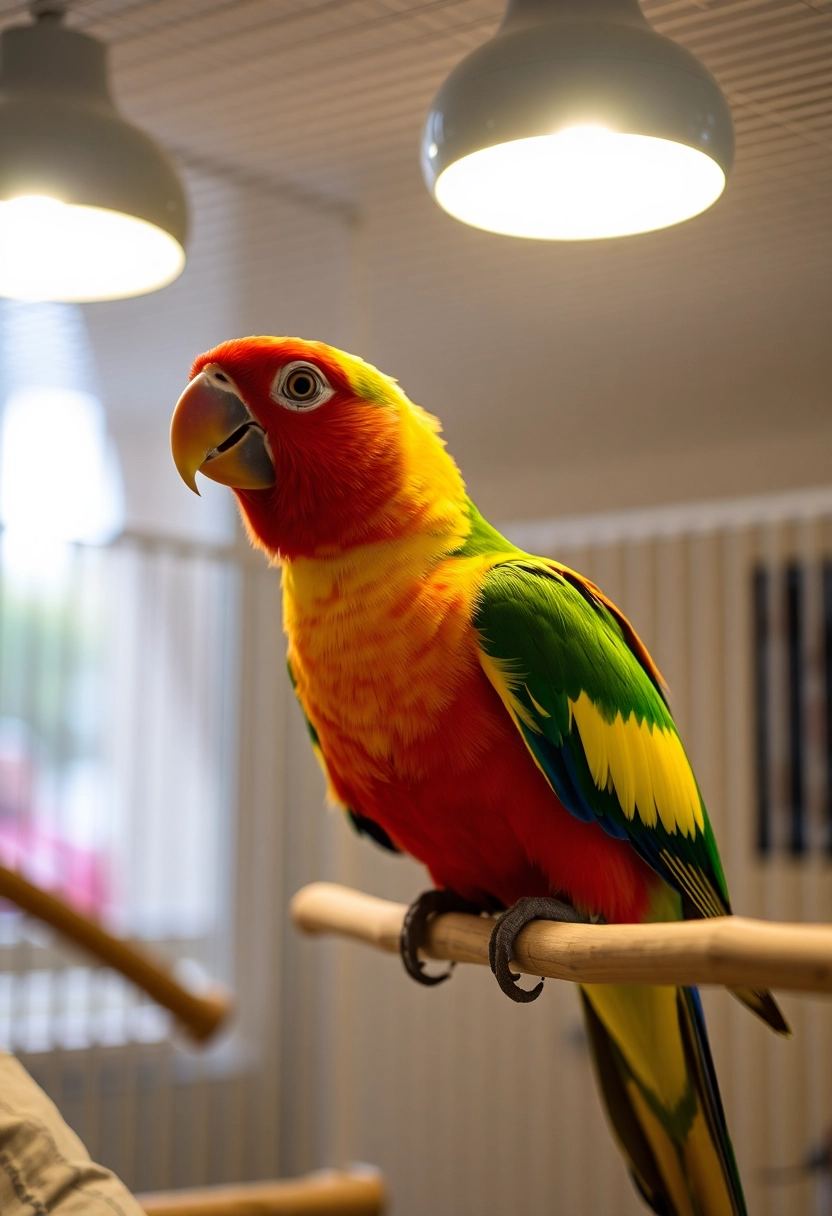
1. Avoid flickering lamps
The RSPCA and other welfare groups explicitly advise not using lamps that flicker, because many birds can see flicker that humans cannot. (RSPCA)
Practical steps:
- Prefer high-quality LED or electronic-ballast fluorescent lamps designed for low flicker.
- Be cautious with cheap LED bulbs or fixtures, especially dimmable ones, which may use low-frequency pulse-width modulation (PWM).
- If you use dimmers, choose ones and lamps that keep flicker frequency very high (hundreds or thousands of hertz).
Poultry specialists suggest that birds can perceive flicker from a flicker index of about 6%, and often recommend lighting with a flicker index well below this. (Earlyfeed)
2. Provide a natural day–night rhythm
Most pet birds do best with 10–12 hours of light and 10–12 hours of dark each day, to mimic natural photoperiods. (BirdSupplies.com)
- Use timers so lights switch on and off at consistent times.
- Avoid leaving TVs or bright screens on in the bird room late at night.
- Ensure the dark period is really dark (or only very dim), so the bird can sleep properly.
3. Use appropriate full-spectrum and UV lighting
Full-spectrum and UVB bird lamps can support vitamin D synthesis, calcium metabolism, and natural behavior when used correctly. (azeah.com)

Guidelines:
- Choose lamps specifically designed for birds, from reputable manufacturers.
- Follow the manufacturer’s distance and exposure-time recommendations.
- Always provide shade and perches where the bird can move out of the strongest light.
- Replace UV lamps as recommended; UV output drops over time even if the lamp still “looks” bright.
Special notes for chickens and other poultry
For backyard flocks and commercial houses, lighting is both a welfare and productivity tool.
Key points from poultry research: (GANAL)
- Chickens typically detect flicker up to at least 75–87 Hz.
- Some technical guidelines suggest using lighting systems with emitted frequency at least 120 Hz, and modern studies on turkeys indicate that 165 Hz and above causes no detectable harm to growth or stress.
- Flicker-free or very high-frequency LED systems have been associated with better egg production, lower mortality, and more stable behavior in laying hens.

For small flocks:
- Use quality agricultural LED poultry lamps or household LEDs with very low flicker instead of old magnetic-ballast fluorescent tubes.
- Ensure the coop has consistent day length and a gradual change in light if possible (dawn/dusk simulation), to reduce startle and piling.
- Check that fans, moving machinery, or slatted floors do not create stroboscopic effects under your chosen lighting.
How to check your lighting for flicker
Because flicker is invisible to most of us, measurement is valuable.
What to look at
Lighting engineers often characterise flicker by: (nvclighting.se)
- Flicker frequency (Hz) – how many times per second the light output changes.
- Flicker percentage or index – how deep the light output varies between its minimum and maximum.
Human-oriented safety recommendations (like IEEE 1789) focus mainly on people, but a good rule of thumb for birds is: the higher the frequency and the lower the flicker percentage/index, the better. (dial.de)
Using tools like the Flicker Meter app

Our Flicker Meter smartphone app uses the phone's camera to estimate flicker frequency and flicker percentage of light sources. This can help you:
- Check lamps over bird cages, play stands, and poultry feeders.
- Compare different bulbs or fixtures before buying more of them.
- Identify “problem” lamps that may need replacing with a low-flicker alternative.
While a dedicated hardware flicker meter gives the most precise results, a smartphone-based tool is a much more affordable and accessible way for many bird owners and small-scale farmers to assessing flicker in their environments.
Key takeaways
- Many birds, including parrots and chickens, can see flicker at frequencies that look steady to humans.
- Chronic exposure to flickering light is linked with stress, behavioral problems, and reduced performance in poultry, and welfare organisations advise against using flickering lamps for pet birds.
- Aim for high-frequency, low-flicker lighting, combined with a stable day–night rhythm and appropriate full-spectrum/UVB exposure.
- Measuring flicker – with a smartphone Flicker Meter or dedicated hardware – allows bird owners and lighting professionals to verify that their lighting really is comfortable for the birds that live under it.
By giving birds light that is steady, natural in spectrum, and well-timed, we support not only their vision, but their health, behavior, and overall quality of life.